
Titan of the Keyboard, Master of the Mind

His only advice was “don’t try this at home.”
Köln Opera House, Germany. Mediocore meal at a bad restaurant, little sleep the night before, senses all messed up, and now the crowning cherry on top is that they brought you the wrong instrument, a tinny-sounding piano which has a strange tone and is more suitable for the accompaniment of a dance rehearsal for a cheap theatre production on the wrong side of town, of which no one knows the name, and even the people who might’ve known have left long ago, leaving memories in the dust.
Well, so be it. No choice but to go on. The people have arrived. Standing off-stage you pump your fist in the air in some sort of half-assed “Power!” gesture to your watchful producer, Manfred Eicher, who’s looking from the wings, and march into the spotlight.
What follows will end up being the best-selling solo piano recording in history.
The story of how it all came to be has been told many times, and has somewhat lost its importance in the larger timeline of Keith Jarrett, in my opinion the greatest musician of the last half-century. I could do here what others have done: go over the recordings in great detail, the achievements, his reinvention of the live piano improvisation medium, the disregard for conventional methods in favour of daring (and daunting) techniques and modes of communication. What continually draws me to Keith’s playing however is the divide at the center of it all. You have an improvisatory mind which is equally capable of submitting itself to the discipline required by the Western classical canon. In his brain, Bach lives as comfortably as does any standard from the great American songbook. To play both merely well is an accomplishment - - to exist in both worlds with astonishing command and fluency is a wonder of the world. And that’s not even the tip of the iceberg. I have records where Jarrett plays wind instruments, percussion, and indeed uses the piano as a drumming tool in itself. The six CDs of Jarrett’s residency - along with The Standards Trio - at NYC’s Blue Note club, contain some of the best improvisation I’ve ever heard… until you realize it’s succeeded by his recordings from the Tokyo ‘96 album a few years later…..wait, maybe it’s the year after that, with 1997’s boundary-breaking La Scala…maybe earlier, his recording of Shostakovich’s piano music perhaps…..ok, let’s speed up to the 21st century, too much to choose from: Radiance (2005), The Carnegie Hall Concert (2006), Testament (2009), Rio (2011)………. I’ve often wanted to compile a supreme, best-of-the-best collection of Jarrett melodies, and while the project has worked for several other acts that I listen to, it is a wholly impossible task with Jarrett. One could spend months listening to just 1 offering from him, such as I did in 2012 with his My Foolish Heart (2007) live trio recording, and still learn new things at the end of it all.
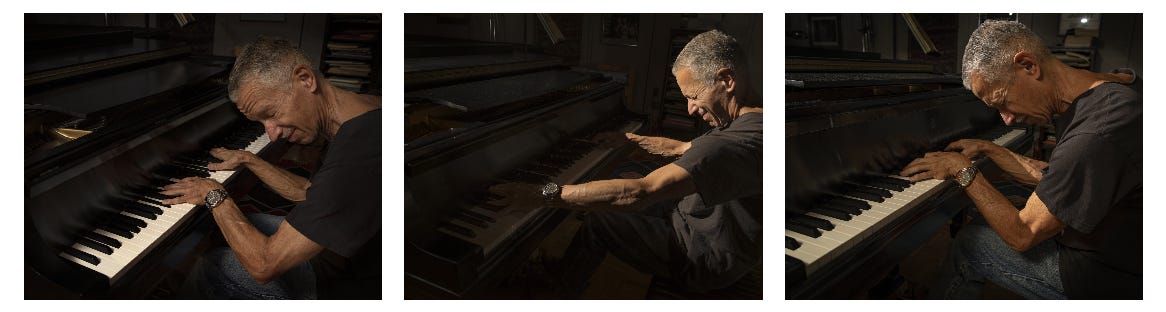
The man didn’t quit because the music literally wouldn’t let him.1 Asked how many songs he knew, he simply replied “very very many.” Along, of course, with his opinion on modern treatments to soothe his ridiculously heavy playing routines: “Doctors - what do they know?” he quipped. Sometimes standing, often howling and making gutteral noises which seemingly emanated from deep within the subconscious, he seemed to embody a multitude of emotions at once. Certainly this was what I experienced when I saw him play live in Toronto, Montreal, NYC and Chicago (following him on the road in 2014). Sometimes, the scene is tortuous, sometimes calming and still. Felled by a crushing illness of what was presumed to be chronic fatigue syndrome in the late 90s, he stopped playing entirely at one point, retreating to the stillness of his converted New Jersey farmhouse, emerging only to record a haunting solo album which must’ve been as painful to play, as much as it is ravishing for the listener to hear. Upon this titanic overcoming of the illness - - and then the literal self-overcoming to return to the stage and embark on new concerts with both the trio and solo realms - - his tenacity and musical endurance fully cemented his legacy.
Today, a surprising sight greeted me. The so-called paper of record is now documenting that vaccine injuries constitute part of what’s palatable and acceptable for “all the news that’s fit to print.” Hehehe, I slowly chuckle to myself, as I drink my morning coffee. Scanning only a few lines of text, I quickly note that all 3 people profiled have hearing damage, in one form or another, in what they suspect was brought on by the dreaded shots. Allopathic medicine, the glory of it all! One staggers. One would even be surprised, if they didn’t see all this coming years ago, and/or was deaf to the terror. Lesson: if we don’t think, we might suffer a fate that’s worse than death. We might, gasp, become seriously hard of hearing to the plight of our fellow man, while pretending to exist.
When I hear Jarrett, sure, I hear a “musician.” But as a first order of business, I hear someone who never stopped thinking, both on stage and off. I have no idea why God designed me with a mind, capable of both discernment and pattern recognition. But then I think to myself: “That’s what music, in the end, really is!”2
The great master unfortunately lost the use of one of his hands after a series of strokes (well before the Covid madness), a twist of fate so cruel that not even Satan himself could’ve spun the tale.
Photos from https://archive.letemps.ch/archive/www.letemps.ch/grand-format/keith-jarrett-mains-miracle.html